The Nile as a Thread of Connection: Technology, Language and Culture Across Millennia
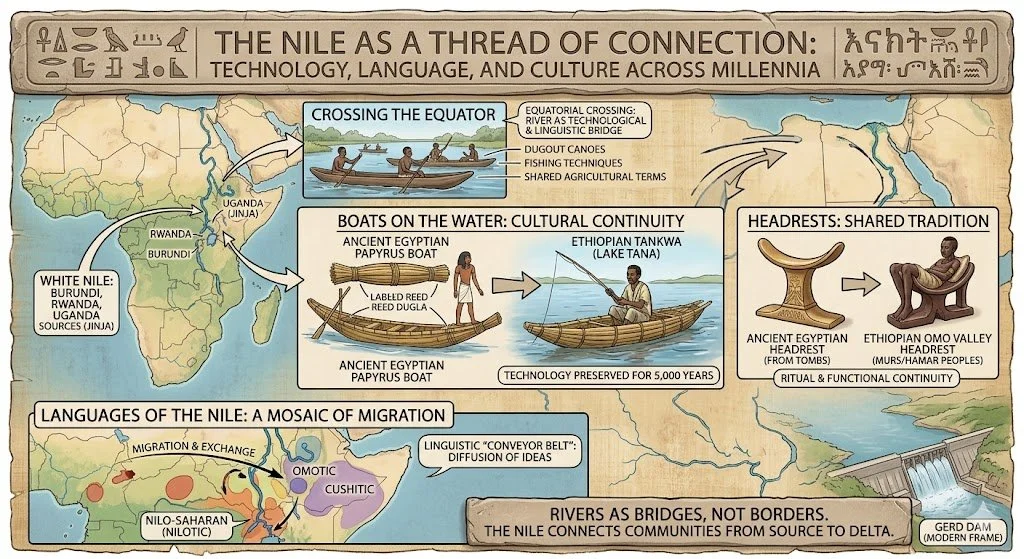
Rivers have always been more than water. They are corridors of movement, channels of exchange, and the arteries through which ideas, languages, and technologies flow. No river illustrates this more powerfully than the Nile—a 6,600-kilometre lifeline stretching from the heart of Africa to the Mediterranean. While often framed today through the lens of modern geopolitical tension, the Nile’s truer history is one of a unifying force that ignored borders long before they were drawn on maps.
The Farthest Reach: Burundi, Rwanda, and the White Nile
The story of the Nile does not begin in a single spot, but in the misty highlands of East Africa. The White Nile has its most distant sources in the Luvironza River in Burundi and the Nyabarongo River in Rwanda. These streams feed into Lake Victoria, the continent’s largest freshwater body.
At Jinja, Uganda, the river makes its dramatic exit from the lake at Ripon Falls, beginning its long journey north. This region—the Great Lakes—serves as the "water tower" of the continent. For the people of Burundi, Rwanda, and Uganda, the Nile is not just a geographical feature; it is the foundation of a shared lacustrine (lake-based) culture.
Crossing the Equator: A Journey Through the Heart of Africa
As the Nile flows north from Uganda, it crosses the equator, transitioning from the lush, tropical rainforests and high-altitude lakes of Central Africa into the vast Sudd swamplands of South Sudan, and eventually the arid Saharan landscapes.
This crossing is more than a climatic shift; it represents the river’s role as a technological and linguistic bridge.
Technological Exchange: The need to navigate the equator's dense marshes and the river’s varying currents led to the diffusion of specific maritime technologies. The design of dugout canoes and fishing gear shows a remarkable continuity from the Great Lakes to the Sudd.
Linguistic Flow: The Nile served as a "conveyor belt" for the expansion of Nilo-Saharan and Bantu languages. As groups moved along the riverbanks, they exchanged agricultural terminology and ironworking techniques. The “Nile Linguistic Corridor" in which words for cattle, grain, and watercraft share common roots across thousands of miles.
Boats on the Water: From Lake Tana to Ancient Egypt
A striking example of cultural continuity is found in the watercraft of Lake Tana, the source of the Blue Nile in Ethiopia. Here, fishermen still navigate in tankwas—buoyant boats made from bundled papyrus reeds.
The tankwa is nearly identical to the vessels depicted in the tombs of the Egyptian Old Kingdom. This is not a coincidence. The Blue Nile was a conduit for movement long before recorded history. The persistence of this technology in Ethiopia is a living artefact of a networked system of exchange that linked the highlands to the Mediterranean delta.
Headrests: A Shared Tradition of Rest and Ritual
In the Omo Valley of Ethiopia, pastoral communities such as the Hamar and Mursi use carved wooden headrests to cradle their heads during sleep. These objects protect intricate hairstyles and carry deep symbolic meaning.
The resemblance to Ancient Egyptian headrests—carved from wood, ivory, or alabaster—is unmistakable. Whether this is a result of "diffusion" (the idea spreading along the river) or a shared ancestral culture, it highlights the Nile as a space where personal and ritual habits remained consistent across disparate ecologies for five millennia.
Languages of the Nile: A Mosaic of Migration
Ethiopia and the surrounding Nile Basin represent a unique linguistic crossroads. It is the meeting point of:
Omotic & Cushitic: Indigenous to the region, with roots stretching toward the Middle Nile.
Nilotic: Part of the Nilo-Saharan family that follows the river through Sudan into Uganda and Kenya.
Recent scholarship suggests that as the Sahara dried out during the Neolithic period, populations converged on the Nile and its tributaries (like the now-dry "Yellow Nile"). This forced proximity turned the river valley into a "melting pot" of syntax and vocabulary, weaving together the diverse identities we see today in the Omo Valley and the Great Lakes region.
The Omo Valley and the Modern State
Despite these ancient links, many Nile communities—such as those in the Omo Valley—were only incorporated into modern states, such as Ethiopia, in the late 19th century under Emperor Menelik II. This integration brought new trade networks but also cultural disruption. Today, the Omo Valley is a testament to the region’s history as a meeting point—a place where Nilotic, Cushitic, and Omotic peoples converged and adapted.
Rivers as Bridges, Not Borders
Today, the Nile is often discussed in terms of the Grand Ethiopian Renaissance Dam (GERD) and water-rights disputes. This framing views the river as a "zero-sum" resource—a line that divides nations.
But the history of the tankwa, the headrest, and the shared languages of the equator tells a different story. The Nile did not create borders; it created communities. It linked the Burundian highlands to the Egyptian Delta, carrying not just water, but the seeds of mutual dependence.
To remember the Nile as a bridge is to recognise that the challenges of the present—water scarcity and climate change—can only be solved through the same spirit of connection that has defined the river for five thousand years. The Nile belongs to everyone who depends on its flow. It is time we viewed it not as a barrier to be guarded, but as a thread to be woven.