The Living Rhythm: How Ancient Egyptian Instruments Shaped the Sound of the Modern World
When we think of ancient Egypt, our minds often drift to the silent grandeur of the pyramids, the golden mask of Tutankhamun, or the deeply etched hieroglyphs on temple walls. But the world of the Pharaohs was anything but silent. It was a civilisation drenched in sound. From the echoing halls of Dendera to the bustling streets of Alexandria, music was woven into the very fabric of daily life, magic, and spiritual devotion.
For those of us who walk the path of the shamanic practitioner, this truth hits close to home. When I sit with my shamanic drum or lock into a rhythm on the djembe, I’m not just playing music; I am engaging in an ancient, cross-cultural technology of soul-flight, healing, and connection. What is truly remarkable is that the soundtrack of ancient Egypt never actually died. Instead, it migrated. Over millennia, the instruments played along the banks of the Nile travelled across the African continent, sailed across the Mediterranean, and evolved into the instruments that drive my own practice—and global music—today.
1. Shaking the Cosmos: The Sistrum and the Modern Rattle
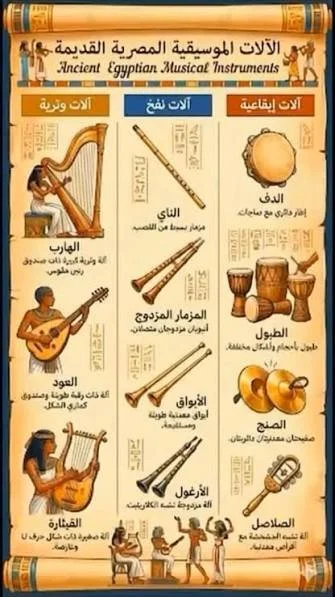
In the temples of the goddess Hathor, music was a form of spiritual medicine. The primary tool for this was the sistrum (known in antiquity as the sesheshet). The sistrum was a sacred metallic rattle, often shaped like the face of Hathor or a stylised loop, fitted with movable rings or discs on crossbars. When shaken, it produced a sharp, shimmering metallic clash meant to mirror the rustling of papyrus reeds and drive away negative cosmic energy (Isfet).
        [THE SISTRUM'S LINEAGE]
  Ancient Egyptian Temple Shaker (Sesheshet)
               │
               ▼
  Ethiopian Orthodox Church Rattle (Sanaṣel)
               │
               ▼
  Modern Percussion / Latin American Maracas & Shakers
As a shamanic practitioner, I recognise the rattle as a classic tool for clearing the auric field and shifting brainwaves into a receptive state. The sistrum didn't vanish with the pharaohs; it moved directly into early Christian liturgy in East Africa and influenced the shakeres and maracas used in shamanic traditions worldwide. Every time I use a rattle to open a sacred circle, I am calling on the very same physics of sound that Hathor's priestesses used to clear the temple of Dendera.
2. The Heartbeat: Frame Drums, Djembes, and the Shamanic Pulse
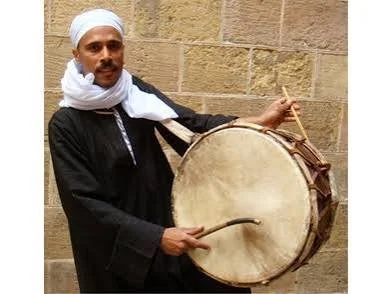
Percussion is the ultimate heartbeat of the cosmos, and ancient Egypt utilised an array of drums that left an indelible mark on global music. Two specific styles directly connect to my own drumming journey:
The Frame Drum and the Shamanic Beat: Ancient Egyptian women, particularly priestesses and dancers, frequently played large, shallow frame drums. These drums were portable and held a deep, trance-inducing connection to the moon, fertility, and rites of passage. This is the direct ancestor of the modern frame drum and the traditional shamanic drums I use in my journeys today. The steady, repetitive beat mimics the womb-pulse, acting as a vehicle for the Ba (soul) to travel astrally.
The Goblet Drum and the Djembe: Excavations have revealed clay, goblet-shaped drums played under the arm. This design directly evolved into the modern darbuka (or tabla) heard in contemporary Middle Eastern music, and heavily influenced the iconic West African djembe—an instrument I hold close to my heart. When my hands strike the djembe, feeling the deep bass in my chest and the sharp slap on my palms, I am speaking a rhythmic language whose syntax was forged on the banks of the Nile.
3. Plucking the Strings: From Harps to Guitars
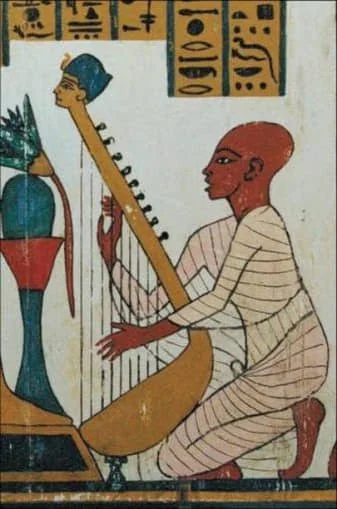
While drums provide the rhythm, stringed instruments carry the soul of Egyptian melody. In the Old Kingdom, massive, arched, angular harps stood as tall as the musicians playing them. Over time, through trade and cultural exchange, these instruments became smaller and more portable, evolving into the neck-lyre and the lute.
The ancient Egyptian lute featured a hollowed wooden soundbox, often covered with animal skin, a long neck, and strings plucked with a plectrum.
[Ancient Egyptian Lute] ──► [North African Guembri / Oud] ──► [Modern Guitar]
As this instrument migrated across Africa, it transformed. In West Africa, it influenced the creation of the ngoni, the kora, and the Moroccan guembri. When enslaved Africans were brought to the Americas, they recreated these stringed instruments using gourds and wood, inventing the banjo. Meanwhile, the lute also travelled through Moorish Spain, evolving into the oud, then the European lute, and ultimately, the modern acoustic and electric guitar.
4. The Breath of Life: Flutes and Reed Pipes
The wind instruments of Egypt were closely tied to shepherds, field workers, and the god Osiris. The ancient Egyptians played the mat, a long, end-blown flute made of cane or reed, which produced a haunting, breathy, deeply emotional sound.
This instrument survived entirely intact and is known across North Africa and the Middle East today as the nay. The nay remains one of the oldest instruments continuously played in human history, its eerie, evocative tone still featuring prominently in cinematic soundtracks and ambient global music today, carrying the listener directly into a meditative, altered state of consciousness.
The Endless Song
Ancient Egyptian music was never lost; it was simply absorbed into the global bloodstream. As a drummer and a practitioner of the sacred arts, knowing that my personal passion for the drumbeat connects me to a lineage thousands of years old gives my work a profound sense of grounding.
When we shake a rattle, beat a hand drum, or strike a djembe, we are not just making noise—we are participating in an unbroken shamanic lineage. The pharaohs have gone, but their music continues to make our souls dance. The Nile Pilgrimage to Egypt in November 2026 will be an homage to this unbroken musical lineage, with each participant bringing their drum, rattle, flute, or an instrument of their choice, with the intention of making music to honour the ancestors and their lands.
P.S. A special thanks to the Egyptologist Mostafa Al Fayomee for an inspiring conversation about material culture and musical instruments in Ancient Egypt. Mostafa will be joining the Nile Pilgrimage to Egypt as our group’s Egyptologist guide this November. For more details about this journey, please contact me.